
Build Autonomous Agentic AI Workflows Without Code
No Code and Agentic AI
 Application closes on
7th May 2026
Application closes on
7th May 2026

 Speak with our expert
+1 844 441 1717
Speak with our expert
+1 844 441 1717




Learn more about the course
Get details on syllabus, projects, tools, and more

No Code and Agentic AI program
Application closes 7th May 2026
Why No Code and Agentic AI?
-

Booming Industry Demand
AI has become a critical component of business, and no-code platforms are closing the gap by enabling professionals to build AI solutions without technical expertise
-
The No Code Advantage
Use no-code AI tools to apply and understand core concepts, enabling both technical and non-technical professionals to lead innovation initiatives without relying on data science teams.


PROGRAM OUTCOMES
Elevate Your Career With No-Code AI
Build proficiency in ML, GenAI, and Agentic AI without writing a single line of code.
-

Build autonomous agents capable of planning, memory, tool use, and executing multi-step tasks.
-
Design systems where multiple AI agents collaborate on complex tasks and measure performance.
-
Transform data into actionable insights using intuitive, no code platforms.
-
Rapidly prototype, test, and operationalize machine learning models without writing code.
-
Leverage supervised and unsupervised learning, recommendation systems, deep learning, and computer vision.
-
Utilize Generative AI, Prompt Engineering, and Agentic AI to design intelligent, autonomous workflows.
KEY PROGRAM HIGHLIGHTS
Why Choose This Program
-
Learn from MIT faculty
Learn from the vast knowledge of 5 award-winning MIT faculty and instructors through recorded sessions.
-
Industry-Relevant Curriculum
Build AI agents, prototypes, and intelligent workflows that drive innovation and enhance productivity.
-
Build your AI Portfolio
Build a portfolio featuring 3 industry-relevant projects to showcase your practical AI capabilities.
-
Personalized Mentorship Sessions
Get mentorship from industry experts in Data Science and Artificial Intelligence based on the concepts taught by MIT faculty.
-
Dedicated Program Support
Connect with dedicated program managers to assist with queries and guide you throughout the course.
-
Innovate With No Code Tools
Gain the skills to design and deploy AI-driven solutions using no code platforms like KNIME, and N8N


Skills you will learn
Artificial Intelligence
Machine Learning
Deep Learning
Prompt Engineering
Generative AI
Agentic AI
Retrieval-Augmented Generation (RAG)
Computer Vision
Supervised and Unsupervised Learning
Model Evaluation & Tuning
Recommendation Systems
KNIME Workflows
Clustering Classification and Regression
LLM Intergation
Ethical and Responsible ai
Artificial Intelligence
Machine Learning
Deep Learning
Prompt Engineering
Generative AI
Agentic AI
Retrieval-Augmented Generation (RAG)
Computer Vision
Supervised and Unsupervised Learning
Model Evaluation & Tuning
Recommendation Systems
KNIME Workflows
Clustering Classification and Regression
LLM Intergation
Ethical and Responsible ai
view more
- Overview
- Learning Journey
- Curriculum
- Projects
- Tools
- Certificate
- Faculty
- Mentors
- Fees
- FAQ

This Program is Ideal For
Professionals from technical and non-technical backgrounds ready to advance their skills in AI
View Batch Profile
-
Business Leaders and Functional Heads
Seeking to lead AI initiatives and guide their teams.
-
Professionals in Tech-Adjacent Roles
Including business analysts and product managers looking to create rapid AI prototypes and build intelligent workflows.
-
Functional Managers
Across marketing, operations, legal, and finance looking to understand AI applications, boost productivity, and design intelligent workflows.
-
Entrepreneurs and Independent Consultants
Aiming to innovate, drive growth, and build practical AI solutions.
Experience a Unique Learning Journey
Our pedagogy is designed to ensure career growth and transformation
-
Learn from world-renowned faculty
Learn critical concepts through recorded video lectures from award-winning MIT professors
-
Engage with your mentors
Participate in live sessions led by industry experts and build application-ready skills
-
Work on hands-on projects
Build a portfolio of industry-relevant projects and case studies to showcase skills
-
Get personalized assistance
Our dedicated program managers will support you through your learning journey




Curriculum
The industry-relevant curriculum includes modules covering Generative AI concepts on Prompt Engineering, Retrieval Augmented Generation (RAG), and Agentic AI, equipping professionals to apply AI solutions using intuitive no-code tools.
Pre-Work
Establish a foundational understanding of data-driven decision-making and gain hands-on experience with no-code tools before the program begins.
Concepts Covered
Week 1: AI, Gen AI, and Agentic AI Landscape
Understand the full arc of AI evolution and contextualize where Generative and Agentic AI fit within the broader landscape.
Concepts Covered
Week 2: LLMs and Prompt Engineering
Understand how large language models work and apply prompt engineering techniques to produce reliable, high-quality outputs.
Concepts Covered
Week 3: Data Exploration
Apply clustering and dimensionality reduction techniques to segment data and extract meaningful patterns.
Concepts Covered
Week 4: Prediction Methods — Regression
Build and evaluate regression models using no-code tools to predict numerical outcomes and identify key drivers.
Concepts Covered
Week 5: Prediction Methods — Decision Systems
Apply classification techniques and ensemble methods to real-world categorization problems, including text classification using LLMs.
Concepts Covered
Week 6: Recommendation Systems
Build and apply recommendation systems using rank-based, content-based, and collaborative filtering approaches.
Concepts Covered
Week 7: Project Week
Predict which hotel bookings are likely to be cancelled to reduce revenue loss and support the design of more effective cancellation policies for a hotel group.
Week 8: Learning Break
Learning breaks are structured pauses that allow you to consolidate concepts, complete pending work, and reinforce your understanding before progressing further.
Week 9: Build Workflows on Proprietary Data and Business Context
Build and evaluate RAG pipelines that connect LLMs to external knowledge sources for more reliable, grounded outputs.
Concepts Covered
Week 10: Evaluating Generative AI Workflows
Apply structured evaluation methods to assess generative AI outputs and optimize prompts for reliability and accuracy.
Concepts Covered
Week 11: Project Week
Help financial analysts extract key information from lengthy annual reports to improve decision-making efficiency.
Week 12: Single Agent Systems
Design and deploy single AI agents that can plan, remember, use tools, and complete multi-step business tasks autonomously.
Concepts Covered
Week 13: Build Autonomous Systems Using Multi-Agents
Design and evaluate multi-agent systems where agents collaborate, hand off tasks, and handle real-world complexity.
Concepts Covered
Week 14: Project Week
Improve support efficiency by implementing an agentic AI system that classifies tickets, retrieves knowledge, generates policy-compliant responses, and handles escalation.
Self-Paced Modules
Note: Weeks are indicative and subject to vary as per holiday schedule for the cohort
Deep Learning and Neural Networks
Computer Vision Methods
Ethical and Responsible AI
Data Exploration: Temporal Data
Case Studies
Apply your learning through real-world case studies guided by global industry experts. Please note: All case studies and projects outlined are indicative and subject to change.
AI-Powered Chatbot to Handle Retail Order Queries
Product Feasibility Intelligence
Global Socio-Economic Segmentation
Streaming Viewership Analysis
Product Sentiment Intelligence
E-Commerce Recommendation Engine
Health Insurance Assistant
Investment Advisory Assistant
Autonomous Inventory Replenishment Agent
Regulatory Intelligence Assistant
Sample Projects and Case Studies
Hands-on practice ensure that learners gain tangible outcomes and highly effective skills.
-
3
hands-on projects
-
14+
case studies

Hospitality
Hotel Booking Cancellation
Description
Focuses on minimizing the financial impact of last-minute hotel booking cancellations by analyzing booking patterns and customer behavior. A predictive model is developed to identify likely cancellations in advance, enabling the hotel chain to implement effective cancellation policies and optimize resource planning.
Skills you will learn
- KNIME
- RapidMiner
- Decision Trees
- Random Forest
- Exploratory Data Analysis (EDA)
- Data Preprocessing
- Data Visualization

Marketing and Advertising
GenAI-powered Review Categorization
Description
Focuses on using Generative AI tools to automate the creation of presentation scripts, specifically for the topic “AI: Revolutionizing Modern Marketing.” It tackles the challenge of transforming complex marketing insights into concise, engaging content that effectively communicates key messages within time constraints.
Skills you will learn
- Prompt Engineering
- ChatGPT
- Perplexity

HEALTHCARE
Agentic Regulatory Intelligence Assistant
Description
Build a no-code, agent-driven system using n8n to automatically monitor global regulatory bodies (FDA, EMA, WHO), extract and summarize key medical device updates, and validate information quality to reduce compliance risk and eliminate manual monitoring.
Skills you will learn
- Prompt Engineering
- Building No Code Agentic AI workflows
- ReAct Framework
- Agentic AI Evaluation

EdTech
Sales Leads Conversion Prediction
Description
Focuses on building a machine learning solution to help an EdTech startup identify high-potential leads from a large pool of incoming prospects. By analyzing user interaction data from digital platforms, the solution highlights key insights into the behavioral patterns that influence lead conversion in online education.
Skills you will learn
- Exploratory Data Analysis (EDA)
- Data Pre-processing
- Decision Tree
- Data Visualization


No-Code Tools Covered
Gain hands-on experience with no code tools to optimize models and build innovative solutions
-
KNIME
-
NotebookLM
-
n8n
-
Google AI Studio
-
Claude





Earn a Certificate of Completion from MIT Professional Education
Certificate of Completion from MIT Professional Education upon successful completion of the program
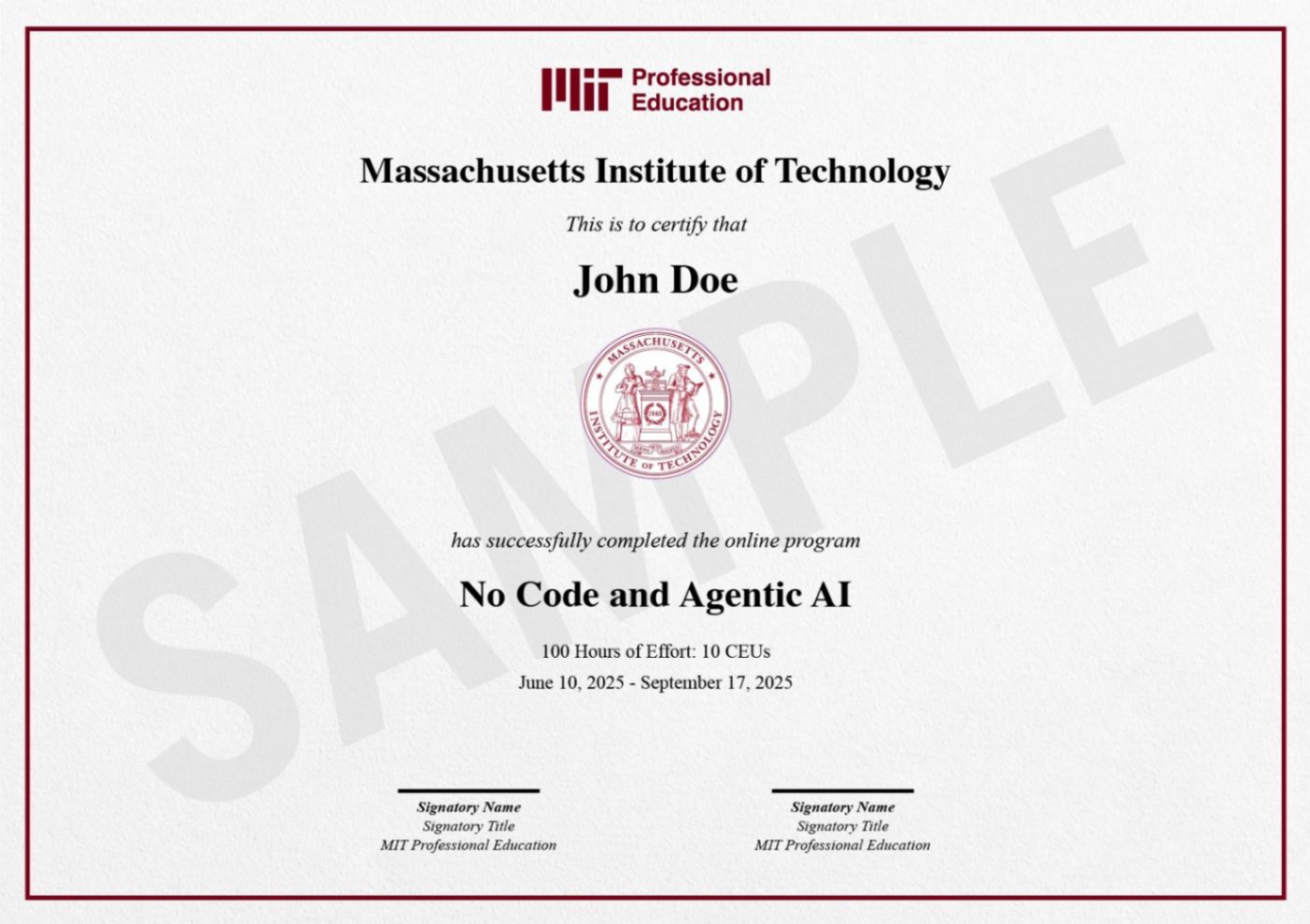
* Image for illustration only. Certificate subject to change.
Program Faculty
Meet our expert faculty & professionals with in-depth AI & ML knowledge and a passion to help you succeed
-
Munther Dahleh
William A. Coolidge Professor, EECS and IDSS; Founding Director, IDSS
Trailblazer in robust control and computational design.
Director propelling interdisciplinary research and innovation.
Know More -
Stefanie Jegelka
Associate Professor, EECS and IDSS
Expert in algorithms and optimization for AI.
Pioneer advancing theoretical machine learning foundations.
Know More -
Devavrat Shah
Andrew (1956) and Erna Viterbi Professor, EECS and IDSS
Renowned expert in large-scale network inference.
Award-winning innovator in data-driven decisions.
Know More -
John N. Tsitsiklis
Clarence J. Lebel Professor, Dept. of Electrical Engineering & Computer Science (EECS) at MIT
Leader in optimization, control, and learning.
Renowned scholar with multiple prestigious accolades.
Know More -
Caroline Uhler
Professor, EECS and IDSS
Expert in computational biology, statistics, and systems.
Award-winning scholar relentlessly driving transformative data insights.
Know More


 LinkedIn Profile
 University Link
Program Mentors
Get guidance from experienced AI and data science experts. Mentor list may change based on availability.
-
Cristiano Santos De Aguiar
Data Scientist, Bresotec Medical
-
Peyman Hessari
Senior Data Scientist, ATB Financial
-
Jatin Dawar
Senior Machine Learning Engineer, Telus
-
Olabode James
Machine Learning Architect, Rubik Technologies






Course Fees
Invest in your career USD 2,850
Course fees
-
Transform data into actionable insights using intuitive, no code platforms.
-
Rapidly prototype, test, and operationalize machine learning models without writing code.
-
Utilize Generative AI, Prompt Engineering, and Agentic AI to design intelligent, autonomous workflows.
-
Earn a certificate of completion from MIT Professional Education, and 10 Continuing Education Units (CEUs)


Easy payment plans
Avail our EMI options & get financial assistance
Third Party Credit Facilitators
Check out different payment options with third party credit facility providers


*Subject to third party credit facility provider approval based on applicable regions & eligibility

Registration Process
Registration close once the required number of participants enroll. Apply early to secure your spot
-
1. Fill application form
Apply by filling a simple online application form.
-
2. Application Screening
A panel from Great Learning will review your application to determine your fit for the program.
-
3. Join program
After a final review, you will receive an offer for a seat in the upcoming cohort of the program.


Batch start date
-
Online · 16th May 2026
Admission closing soon
Delivered in Collaboration with:

MIT Professional Education is collaborating with online education provider Great Learning to offer No Code and Agentic AI. This program leverages MIT's leadership in innovation, science, engineering, and technical disciplines developed over years of research, teaching, and practice. Great Learning collaborates with institutions to manage enrollments (including all payment services and invoicing), technology, and participant support. Accessibility
 Application Closes
7th May 2026
Application Closes
7th May 2026

Frequently asked questions
What is the required weekly time commitment?
The program consists of 10 modules, totaling approximately 80 study hours. Most participants can expect to spend an average of 6 to 12 hours per week on program activities.
Is the program completely virtual?
Yes. The program is delivered entirely online, allowing you to learn from anywhere. It is designed to meet the needs of working professionals and enables you to develop practical skills in AI and machine learning over a 12-week period.
What are the best No Code AI tools in the market?
What is the application of no-code AI in different industries?
No-code AI enables a wider range of business professionals to develop automation solutions and create software applications without prior coding experience. Organizations across sectors such as IT services, education, BFSI, marketing and advertising, FMCG, and manufacturing have adopted no-code AI and machine learning approaches. Here’s how leading industries are leveraging no-code AI approaches:
Finance: Streamlines processes such as loan approvals and customer experience management. No-code AI helps predict financial risks, anticipate customer churn, and design personalized customer experiences.
Marketing: Supports data analysis and model-building to inform strategic decisions. For example, marketers can segment customer data and lifetime value to tailor targeted campaigns on platforms like Facebook.
Healthcare: Facilitates collaboration between doctors and patients by providing deeper insights into patient health. No-code AI tools enable healthcare professionals to develop customized solutions for patient care.
Education: Helps track courses and manage admissions efficiently. Schools and universities can use no-code AI to handle workloads, expand outreach to students, and improve operational efficiency.
Technology: Enhances cybersecurity by tracing the origin of cyberattacks. Tech professionals can use no-code AI platforms to detect threats and block attackers using data such as port maps.
Will this program provide similar career outcomes to a program that includes coding like Python?
Yes. The career outcomes of this program are comparable to those of a traditional data science program. You will develop the capability to design data-driven solutions, interpret AI outputs, and apply problem-solving skills to real-world use cases in artificial intelligence and machine learning. While Python and other coding tools are commonly used in traditional programs, this program leverages no-code AI platforms to implement solutions, so programming skills are not required during the learning journey.
What kinds of projects and case studies will I work on in this program?
The case studies and projects are based on multiple industry sectors, including Education, Healthcare, IT, Finance, Retail, Research, and many more.
Does the program reflect the latest technology developments in No Code AI?
Will I receive a transcript or grade after completion of the program?
Participants receive performance marks for each assessment and module to evaluate their understanding and determine eligibility for the certificate. Upon successful completion of the program by achieving a minimum score of 80 percent in each module, you will be awarded a Certificate of Completion from MIT Professional Education.
Will I have to spend extra on books, virtual learning materials, or license fees?
No. All required learning materials are provided online through the program’s Learning Management System. However, because the field of AI is vast and constantly evolving, a list of recommended books and additional resources will be provided for those who wish to explore topics in greater depth.
Can my employer sponsor the program fee?
We accept corporate sponsorships and can assist you with the process. For more information, please reach out to us at ncai.mit@mygreatlearning.com.
What is the refund policy?
Please note that submitting the registration fee does constitute enrolling in the program, and the below cancellation penalties will be applied. If you are unable to attend your program, please review our dropout and refund policies below:
- Dropout requests received within 7 days of enrollment and more than 42 days prior to the commencement of the program will incur no fee. Any payment received will be refunded in full.
- Dropout requests received more than 42 days prior to the program but more than 7 days after the acceptance are subject to a cancellation fee of USD 250.
- Dropout requests received 22-41 days prior to the commencement of the program are subject to a cancellation fee equal to 50% of the program fee.
- Any dropout requests received fewer than 22 days prior to the commencement of the program are subject to a cancellation fee equal to 100% of the program fee.
- No refund will be made to those who do not engage in the program or leave before completing a program for which they have been registered.
What are my payment options?
For further details, please get in touch with us at ncai.mit@mygreatlearning.com.
What are the prerequisites for this No Code and Agentic AI program?
What skills are needed to excel in no-code AI?
No programming or advanced mathematics knowledge is required to participate in the No Code and Agentic AI program : Building Data Science Solutions Program. Familiarity with basic statistics and mathematics is recommended to maximize your learning experience and effectively apply the concepts taught in the program.
What is the Application process?
To apply, complete the online application form. The Great Learning program team will review your submission to assess your fit for the program. If selected, you will receive an offer for the upcoming cohort and can secure your seat by completing the program fee payment.
Why no code AI and machine learning?
Businesses are starting to adopt no-code approaches to reduce costs, improve the efficiency of their existing solutions, and accelerate time to market. The no-code approach enables AI and ML for everyone, making processes more scalable. Even professionals with no coding experience can now apply these advanced technologies to build intelligent solutions and help make informed decisions.
What is the future of no-code AI and machine learning?
The post-pandemic shift has led to increased adoption of digital technologies. Gartner projects a 23% increase in the global market for no-code tools and development. There is a steady growth in the use of no-code approaches due to their effectiveness in addressing some of tech’s most significant challenges—digitizing workflows, improving customer and employee experiences, and boosting the efficiency of operational teams

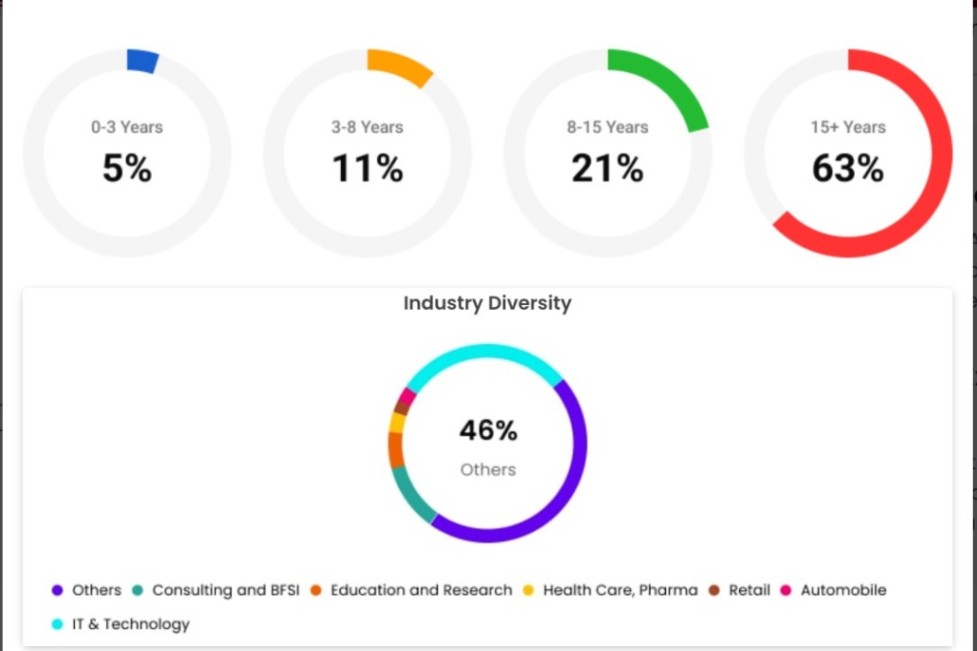
Batch Profile
The Data Science and Machine Learning class consists of working professionals from excellent organizations and backgrounds maintaining an impressive diversity across work experience, roles and industries.
Hey there! Welcome back.

Forgot your password? No problem.

You are already registered. Please login instead.
Login
Forgot Password?
Enter your registered email and we'll send you a link to change your password.